What an AI-generated answer changes compared with a Google link
A Google results page offers a list. The reader arbitrates, compares, opens two or three pages. A generated answer does the opposite: it keeps a few sources, rewrites them, and returns a single text.
The consequence is blunt. On Google, sixth position earns little, but it exists. Inside a generated answer there is no sixth position.
- The reader sees several options and compares them
- An average position can be measured and tracked
- Moving from ninth to fourth place is visible
- The click remains the unit of measurement
- The reader sees a summary and a few sources
- Measurement becomes binary: quoted or absent
- No visible progress until the threshold is crossed
- A brand mention counts as much as a click
Why an AI quotes a company, not a page
The common advice on the subject fits in one sentence: "write for the AIs". It is wrong, and it is what wastes the most time.
An assistant recommending a supplier does not recite a page. It names an entity whose existence it has been able to establish: a name, an activity, a place, profiles that corroborate each other. A perfectly written page on a site that never says who publishes it stays an anonymous page, and an AI does not recommend an anonymous party.
It is easy to verify. Ask an assistant to describe your company. If it hesitates, or gets the sector or the city wrong, no article rewrite will fix that: what is missing is the identity record, not the prose.
The five checks that decide, before writing a single line
The Atelier SEO technical audit runs more than ninety checks. Five of them bear specifically on readability by answer engines, and those are the ones to clear first.
| Check | What it verifies | What its failure costs |
|---|---|---|
| AI05: identity record | Organization markup and links to your official profiles. | The site stays an anonymous page, attached to no company. |
| EEAT05: trust signals | Who you are, where you are, how to reach you. | The assistant has nothing to quote you on without risk. |
| AI02: AI crawler access | Whether your robots.txt blocks assistant crawlers. | An unintended block makes you unreadable, with nothing to signal it. |
| AI01: llms.txt file | The robots.txt equivalent for assistants: what they may read. | A cheap bet on an emerging practice, not a guarantee. |
| AI04: marked-up questions | Your question-shaped subheadings, described in structured data. | Answers you already wrote stay unusable as they are. |
Two honest remarks on this table. AI02 is the only one with an immediate, certain effect: clearing an unintended block makes the content readable again. AI01 has no measurable effect to date; it is a bet, and the audit says so rather than selling it as a lever.
None of these five checks requires writing anything. That is precisely why they come first.
The basket of 10 questions to test yourself this month
The method below works without any tool. A reading is only worth something if it can be reproduced: the same ten questions, in the same order, every month. Changing one breaks the comparison.
They are short questions, because nobody writes a paragraph to query an assistant. The second column shows the page meant to answer. If a question quotes nobody while a page covers the subject, that page is the one to strengthen.
| Question asked to the assistant | Page meant to answer |
|---|---|
| What's the best free SEO audit tool? | /en/audit-seo |
| A simple SEO tool for a small business, no jargon? | /en/audit-seo |
| Which SEO tool tells me which pages to fix first? | /en/audit-seo |
| An SEO tool that connects to my Search Console? | /en/vos-donnees-google |
| How do I know if ChatGPT mentions my company? | /en/blog/chatgpt-perplexity-citation-test |
| My site lost its rankings after a rebuild, which tool? | /en/blog/website-redesign-seo-checklist |
| Fix or rebuild my website, how do I decide? | /en/audit-seo |
| SEO audit tool in plain language for beginners? | /en/audit-seo |
| An agency that rebuilds the site and applies the fixes? | /en/pricing |
| How do I check an SEO agency's real results? | /resultats-seo |
Twenty minutes a month, no paid tool, a series that stays comparable over time. A simple measurement repeated beats a precise one abandoned in month two.
Which is more reliable for company research, ChatGPT or Perplexity
No universal winner, and that is good news: the two do not fail in the same place.
- Shows numbered sources next to the text
- The reading is taken straight from the source list
- Favours recently published or updated pages
- Quick to verify, including for a non-specialist
- Synthesises more, and cites depending on whether a web search runs
- Without search, the answer comes from training, so without sources
- May name a company with no link, which still counts
- Requires checking whether the answer draws on the web
Record the two separately. A company quoted by Perplexity and absent from ChatGPT does not have the same problem as one absent from both: in the first case the pages exist and can be found, in the second there is nothing to quote.
A mention without a link counts. The reading therefore records the mention and the source separately.
What the AI Visibility screen shows, and what it cross-checks
The manual reading has one limit nothing makes up for by hand: a single answer per question per month, while an assistant never answers twice the same way. A "not quoted" on Tuesday becomes a "quoted" on Thursday with nothing having changed on the site.
In the Atelier SEO workspace, the AI Visibility tab answers this by changing the unit of measurement. Its "how we measure your AI visibility" panel puts the method on screen instead of asking you to believe it.
Each question is asked several times across four engines. What appears is a mention rate with its margin of error, which tells a real movement apart from generation noise.
Being named in the text, being cited as a source and coming first in the answer are three different things. The screen distinguishes them instead of merging them into one score.
A question with no completed reading does not show zero, it stays empty. A zero is a result, a missing measurement is not, and confusing the two turns an outage into an apparent failure.
The rate per question is set against the pages actually quoted, the AI readability checks from the audit, and what Search Console returns on the same subjects. That cross-check is what says whether to fix the identity, the page, or to wait.
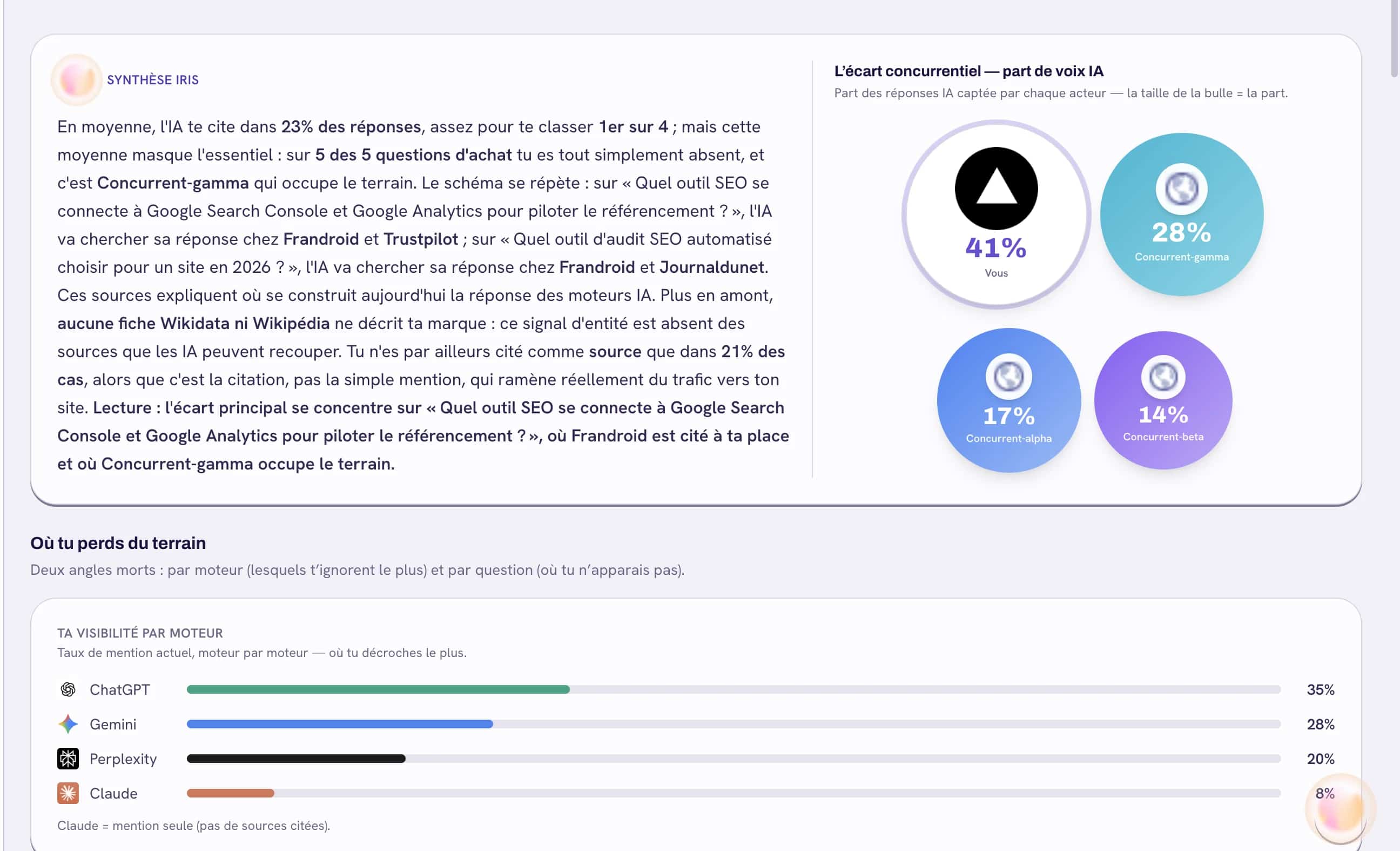
That last point is the one that cannot be reproduced by hand. Knowing that a question quotes nobody does not say what to do. Knowing that it quotes nobody, that the page meant to answer has no impressions in Search Console, and that the identity check is failing, points to a single action.
What happens once the reading is in
A reading fixes nothing. What follows is a work order, and that is where Iris comes in: it reads the reading alongside the rest of the site data, then ranks the corrections in the order where they produce an effect.
- Clear the identity checks
AI02 first if it blocks, then AI05 and EEAT05. As long as the company is not identifiable, the rest cannot be measured.
- Strengthen the pages meant to answer
For every question with no mention, the target page is named, along with what it lacks: an answer at the top, a readable structure, explicit entities.
- Ask the same basket at the next reading
Same questions, same protocol. It is the only way to tie a movement to a correction rather than to a model update.
- Apply, if the site cannot follow
When corrections hold, support is enough. When the site cannot carry identity signals without being rebuilt, the formula with a redesign included, committed over six months, exists for that.
Order matters more than speed. Strengthening ten pages before clearing a crawler block means writing for a reader who is not allowed in.
The Atelier SEO observatory
The same ten-question basket is applied to this website, and every reading will be published here, one row per month.
Publishing your own reading commits more than a method article. A month with no citation at all will be published as is, exactly as the months with no clicks already appear in the public results journal.
| Column | What goes in it |
|---|---|
| Question | The exact wording from the basket, never rephrased from one month to the next. |
| Assistant | The name of the product queried and its version, recorded on the day of the test. |
| Quoted or not | Yes if the company name appears in the text or in the sources. No otherwise. |
| Source quoted | The exact address of the page reused, when the assistant gives one. Empty if the mention carries no link. |
| Test date | The day of the reading. Two readings of the same month a fortnight apart are not comparable. |
The rule is the same as on the public results journal: the measurement period comes with every figure, and flat months stay online.
How do you get quoted by ChatGPT and Perplexity?
No method guarantees it. Start by making the company identifiable: a marked-up identity record, trust signals, a robots file that does not exclude assistants. Only then do a direct answer at the top of the page and a readable structure make your pages reusable.
Do you have to test in private browsing?
Yes. A signed-in session personalises answers from your history, which makes the reading incomparable from month to month and different from what a prospect would see.
Does a mention without a link count as a citation?
It counts as a brand mention, and the reading records it separately from the quoted source: it brings no visit, but it does build recognition.
Does a rate of zero mean nothing is working?
Not necessarily. A measured zero is a result; a missing measurement is not. That is why a question with no completed reading stays empty rather than showing zero.

Trust & E-E-A-T