Atelier SEOBuilt by La Refonte the agency that actually grows your traffic.Book a strategy audit →

The demonstration, not the promise

AI assistant connected to your website data: the Iris demo

One SEO prioritisation question, asked twice. First to an assistant with no access to the data. Then to Iris, connected to the technical audit and the Search Console of the website. Both answers are reproduced as they came.

Short answer

What an assistant connected to your data does differently

A generic AI assistant answers from general knowledge. A connected assistant first reads the data of the website: technical audit, Search Console, pages actually online, competitors. The difference is not the quality of the advice, but its order. Connected advice names a page, a query and an action. Generic advice names a best practice.

The test

The same question asked without data, then with Iris connected

The website used for this demonstration is Atelier SEO itself. Its technical audit, its content plan and its Search Console figures are public, so every claim below can be verified without taking this page at its word.

The question asked

On this website, which page should be worked on first for search?

Answer from a generic AI with no access to the data

Start with your pillar pages. Check title tags and meta descriptions, improve loading speed, strengthen internal linking. Publish content regularly and monitor Search Console.

The advice is sound. It would be identical for any website, which is exactly its limit: it does not say where to start on this one.
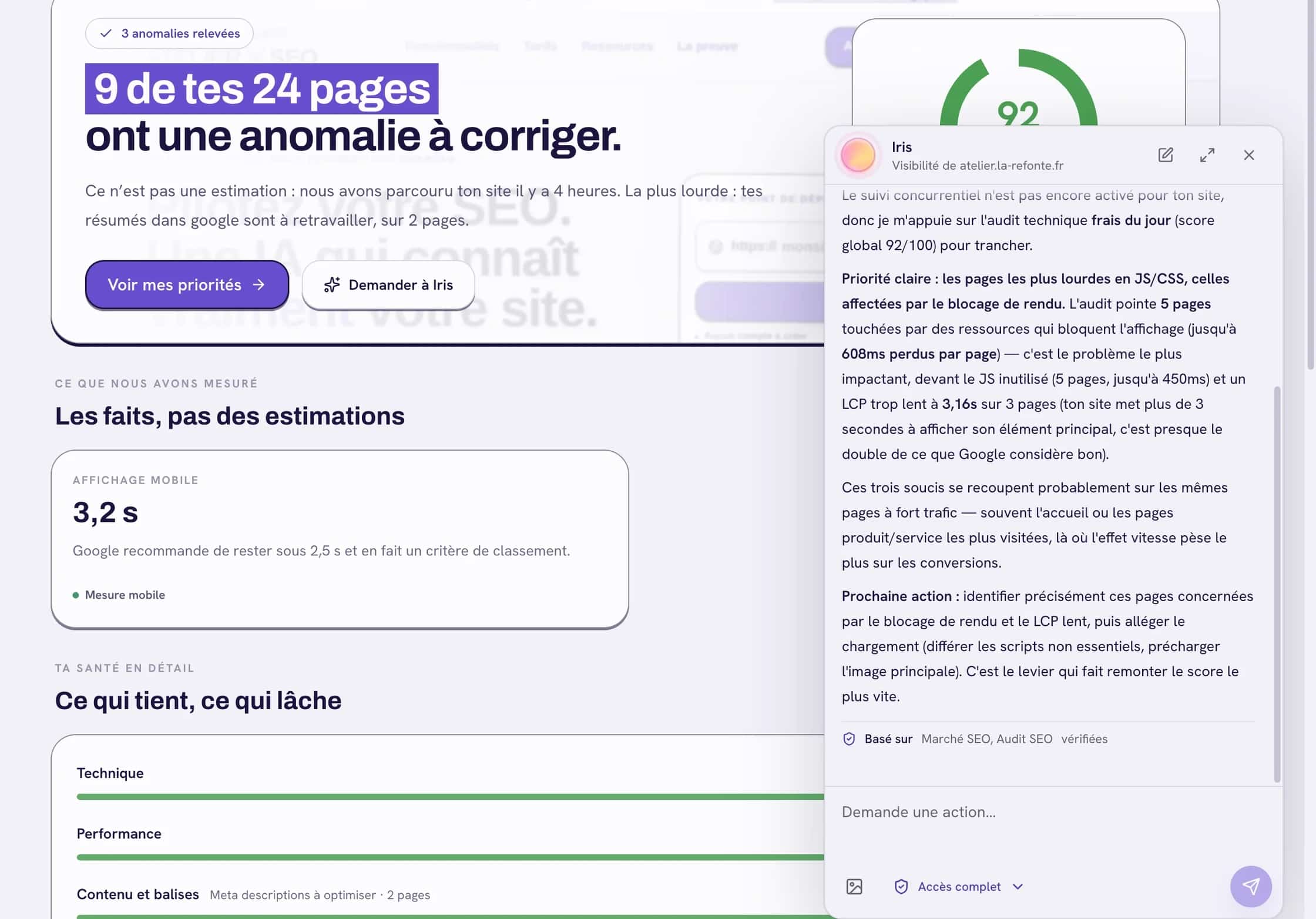
Answer from Iris with the audit and Search Console connected

Three pages cover the same "SEO audit" intent: the home page, /audit-seo and /audit-seo-site. They will compete for the same queries as soon as impressions begin. The home page keeps the role of general entry point. /audit-seo should document what the ninety checks actually contain, the only defensible difference from the home page. Search Console still returns no clicks over ninety days, so the success criterion has to be measured in absolute terms at the first appearance of data, not as growth.

This answer names three precise addresses, a conflict between them, a role for each page and a measurement criterion suited to a website with no history. None of it can be deduced without reading the site and its data.

What follows belongs to a human, and it diverged. Rather than keeping three separate pages, the team consolidated /audit-seo-site into /audit-seo on 7 August 2026. The assistant detected the conflict and framed the trade-off; the decision to merge was taken by a consultant. That consultant has a name and a track record: who writes the analyses published here.

Both sources quoted here can be consulted: the content plan of the website, the public results journal.

The comparison

Generic answer and connected answer, row by row

Both answers address the same question. The table does not compare their style, it compares what each one is able to name.

What the answer containsAssistant without dataIris connected to the site
Pages namedNone. "Your pillar pages" describes a category.
Source of the diagnosisGeneral search engine optimisation practice.
Order of workA list of tasks, with no priority between them.
Success criterionMonitor Search Console.
Verifiable by the readerNothing to verify, nothing is specific to this site.

The generic answer is not wrong. It is true for everyone, which makes it unusable for deciding what to do on Monday morning.

The mechanism

What changes in prioritisation when Iris can read the website data

Three recommendations from the example above are out of reach for an assistant with no access to proprietary data. They do not require better reasoning, they require a reading.

Spotting two pages competing for the same query

Cannibalisation cannot be deduced from a topic. It is observed by crossing the pages actually published with the queries they appear on. Without the crawl and without Search Console, the conflict stays invisible.

Fitting the measurement to the real history

A website with zero clicks over ninety days cannot be judged on a growth percentage. Iris reads that zero and switches the measurement to absolute values. An assistant without data proposes a percentage increase, which means nothing from zero.

Only proposing links to pages that exist

Recommended internal links are checked one by one against the list of addresses actually online. That is what stops an action plan from sending a writer to link to a page that was never published.

The objection

Does a business owner really need a tool connected to their data?

The question deserves a direct answer, because a generic assistant costs less and replies faster.

The limit is not the power of the model. A generic assistant has no access to the proprietary data of a website: not its crawl, not its Search Console, not its ranking history. It therefore cannot know which of two pages already receives impressions, nor which of the two deserves to be kept.

As long as the question is about method, a generic assistant is enough. As soon as it is about this specific website and the order of the work, it can only answer at the level of the category. The difference is paid in time lost on the wrong tasks.

Setting it up

How to bring AI to your website without starting over

Iris is a layer connected to an existing website, not a tool installed inside it. Nothing is added to the website code, and no migration is required.

  1. The audit runs from outside

    The website is crawled the way a search engine would, from its public address. No server or CMS access is needed to produce the first diagnostic.

  2. Google data connects read-only

    Search Console and Analytics attach through a Google account, in read-only mode. The connection can be removed whenever you decide, and the permissions stay visible on the Google side.

  3. Recommendations come out in plain language

    The action plan is read and applied in the CMS already in place. It assumes no change of technology and no dependency on the tool in order to publish.

Once connected

What Iris does once the website is connected

The description below is functional. It covers what can be observed in the workspace, with no promise of results.

Dated technical audit

More than ninety checks across four families, replayed on every new audit, with the affected URLs attached to each finding.

Search Console monitoring

Positions, impressions and clicks by page and by query, on a rolling window, kept separate from estimates.

Prioritisation by business impact

Findings are ranked by their observed effect on indexing, clicks or speed, rather than by a generic scale.

Action plan writing

Every task comes with its target page, its search intent, its verified internal links and its measurement criterion.

Iris open over the workspace, answering a prioritisation question with its sources named.
Iris answering on atelier.la-refonte.fr the question "Which page should I work on first, and why that one?". The answer draws on the audit run that day, quantifies the affected pages, states what it does not have, and names its sources at the bottom.

Your baseline

The same demonstration, on your website

Run the audit, connect Search Console, then ask the question that concerns you.

Shall we talk?