What counts as a low-traffic page, exactly
A low-traffic page is a live, indexable page that brings almost no visits from search results. The phrase stays vague until you set markers. Three are enough, and all three are read in Search Console.
- Content debtlow-traffic pages · content decay
The set of pages published then left as they are, still crawled and indexed while producing neither a visit nor an action. It is measured like a financial debt: by its outstanding amount and by what it costs to carry, not by a page count.
The first marker is the impression. A page that never appears in results does not carry the same diagnosis as a page displayed without being clicked. The first has not found its topic. The second has a topic but fails at display time.
The second marker is average position. A page on the second page of results sits close to the visibility threshold. A page beyond the fifth is far from it, and the work required is not of the same nature.
The third marker is age. A page published three weeks ago has not been judged by Google yet. Judging it now means deciding without data.
Why those pages weigh on the whole site
A page with no traffic is not neutral. It consumes three resources the site shares across every address.
The first is crawling. Google's robot allocates a visiting time per site. Every useless page crawled is a visit that did not serve an important page.
The second is topical clarity. A site covering ten serious subjects and forty skimmed ones looks less specialised than a site covering only ten. The signal sent is dispersion.
The third is your own attention. A list of two hundred pages with no priority always produces the same result: nobody starts.
The check that spots them in the workshop
The Atelier SEO technical audit runs more than ninety checks. Three readings cross to isolate the pages concerned, and none is enough on its own.
Crawling rebuilds the internal link graph of the site. From it, each address gets its click depth from the home page, its number of inbound links, and whether it is orphaned. A page at four clicks or more, or with at most two inbound links, surfaces as a page to handle.
Search Console adds the real trajectory: impressions, clicks and average position, per page. That is what separates an ignored page from a page displayed but never chosen.
Crossing the two produces the useful list. A buried page already getting impressions is fixed through internal linking. A well-linked page with no impression at all raises a question of topic.
- What crawling sees
Click depth from the home page, inbound links, orphan pages, pages duplicating an intent. This reading requires no Google account.
- What Search Console adds
Impressions, clicks and average position per page, over the available window. It is the only source that says whether Google already displays the page.
- What the crossing produces
An ordered list where each page carries the reason it is there: never displayed, displayed without a click, buried, orphaned, or competing with another page of the site.
The families of checks and what each one verifies are described on the technical audit page.
Four possible decisions, and how to choose
Should a page with no traffic be deleted? The question is badly framed. Four outcomes exist, and the trigger differs for each.
Improve: when the page has real potential
Trigger: the page gets impressions, at a position between eleventh and thirtieth. Google understood its topic and hesitates to move it up.
The gap then plays out on content depth, on the clarity of the displayed title and on inbound linking. A page in that zone offers the best effort-to-result ratio, because the data already validated the topic.
Merge or redirect: a cannibalisation signal
Trigger: two pages or more surface on the same queries, and none prevails. That is cannibalisation, and it is read directly in Search Console.
Merging or redirecting a page means choosing which page keeps the topic, pouring the best of the other into it, then setting a 301 redirect from the abandoned address. The redirect is not a formality: without it, existing links fall into the void.
Delete: when the page is useless or harms the whole
Trigger: no impression, no inbound link, no commercial role, and a topic no other page claims.
Here too, deletion alone is rarely the right move. Archiving goes through a redirect to the closest page, or a 410 code when no page matches. An address removed without instruction leaves an error the robot will keep visiting for months.
Keep: pages that are useful despite little traffic
Trigger: the page serves something other than search. Legal notices, a thank-you page, product documentation, a page read by your existing customers.
Those pages are not meant to generate visits from Google. Counting them in the content debt distorts the diagnosis.
| Outcome | What triggers it | The move, in one sentence |
|---|---|---|
| Improve | Impressions present, position beyond the first page. | Deepen the content, rewrite the displayed title, strengthen inbound links. |
| Merge or redirect | Several pages surface on the same queries. | Pick the page that keeps the topic, pour the other into it, set a 301 redirect. |
| Archive | No impression, no inbound link, no commercial role. | Redirect to the closest page, or return a 410 if none matches. |
| Keep | The page serves something other than search. | Take it off the list: it does not belong to the content debt. |
How to bring visitors to the pages that deserve them
Sorting the debt frees up time. What remains is where to reinvest it, and the answer rarely lies in publishing one more page.
Start with pages already getting impressions without clicks. They are displayed, so the topic holds. What is missing happens at display time: a cut-off title, a vague promise, a misread intent.
Continue with internal linking. A page no other page cites stays alone. Adding three contextual links from nearby pages costs a few minutes and lifts the page in the structure. The subject is covered in detail in our guide on pages buried in the site structure.
Finish with creation, and only then. A new page is justified when a search intent is covered by none of your existing pages. That is a gap, not a wish.
What happens once the list is sorted
A sorted list is worth nothing without an order of execution. That is the role of the action plan: every page carries its decision, its reason and its rank.
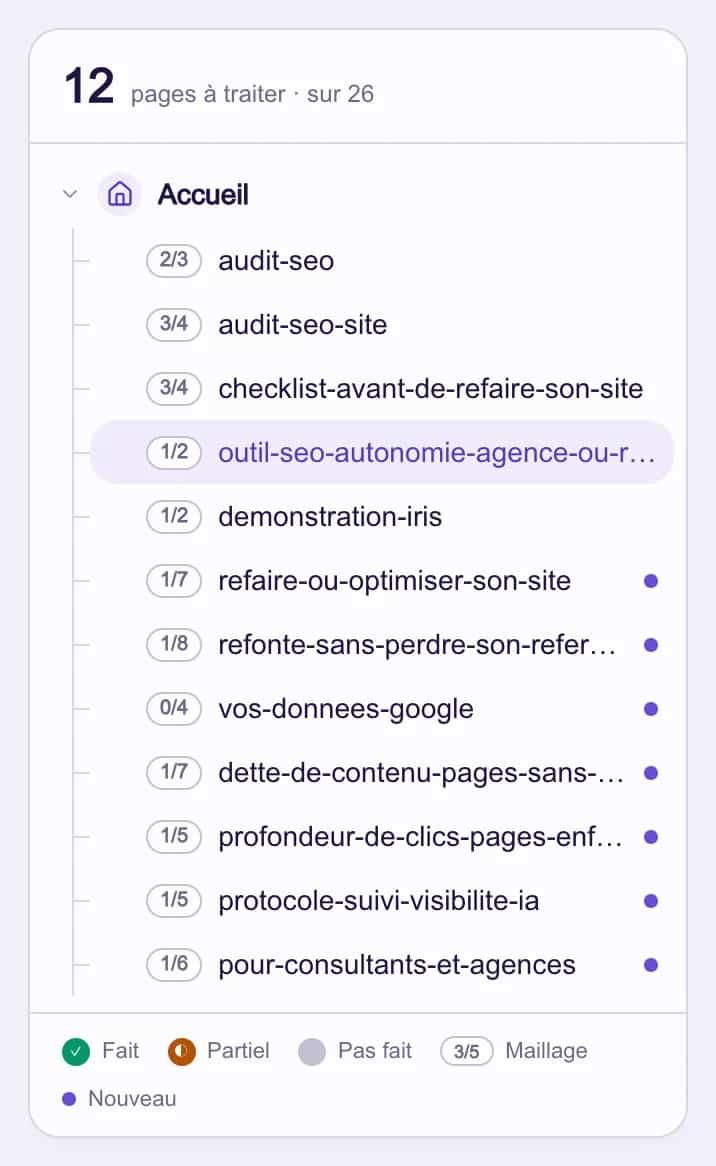
Iris, the workshop's assistant, sets that rank from the same data as the audit and Search Console. It does not offer a general best practice, it names a page and a reason. The demonstration on a real case reproduces the same question asked without data, then with it.
One objection comes up often, and it is legitimate: the fear of deleting the wrong page. It is answered by method, not by caution. An archived page keeps its redirect, so its address keeps working. A decision taken stays written from one cycle to the next, which avoids reopening the same debate on the same pages every month. The full sequence is described in our working method.
Should a page with no traffic be deleted?
Rarely, and never by default. Deletion is only justified if the page has no impression, no inbound link and no commercial role. Even then, the address must be redirected or return a 410 code, otherwise the error will keep being visited for months.
How long before a page can be judged?
Wait until Google has displayed it over a full measurement window. A recent page with no impressions has not failed: it has not been evaluated yet. Deciding earlier means deciding without data.
How do I know if two pages cannibalise each other?
Look at Search Console queries page by page. If the same queries surface two addresses of your site and neither settles, the competition is internal. Merging, with a 301 redirect to the page you keep, is then the right outcome.
Can a page with no traffic harm the rest of the site?
It does not mechanically penalise other pages. It consumes crawling time and dilutes the site's topic. The effect is indirect and gradual, which is why it goes unnoticed for so long.

Trust & E-E-A-T